publications
Please find below the list of my research publications.
2025
- Spatiotemporal characterization of gait kinematics in motor impairments with machine learning : from signal to image analysisLorenzo HermezInstitut Polytechnique de Paris, Oct 2025
@phdthesis{hermez_spatiotemporal_2025, address = {Evry, France}, title = {Spatiotemporal characterization of gait kinematics in motor impairments with machine learning : from signal to image analysis}, hal = {tel-05312265}, language = {en-US}, school = {Institut Polytechnique de Paris}, author = {Hermez, Lorenzo}, month = oct, year = {2025}, } - Gait asymmetry assessment through Eigen-Gait components on dissimilarity mapsLorenzo Hermez, Nesma Houmani, Sonia Garcia-Salicetti, Omar Galarraga, and Vincent VigneronComputers in Biology and Medicine, Jan 2025
Motor impairments caused by neurological diseases have an important impact on gait, particularly on the coordination between left and right lower limbs. Deviation from normal gait is often measured to assess this impact on gross motor functions, and to monitor the progress of patients during rehabilitation. The concept of gait dissimilarity map is introduced to represent bilateral raw gait signals, while accounting for their respective spatiotemporal dynamics. A model of gait for the healthy population is constructed through Singular Value Decomposition, considering both lower limbs. The obtained eigenvectors synthesize the symmetry present in gait. Then, by projecting the dissimilarity maps of patients with gait disorders on the space formed by such eigenvectors, we compute their associated Eigen-Gait Asymmetry Index (EGAI) relatively to an average normal gait reference vector. For the knee joint in the sagittal plane, EGAI values of patients are higher (9.73 ±2.16) than those of healthy controls (3.86 ±0.9), reflecting the asymmetry induced by neurological diseases. Patients with hemiparesis show the highest EGAI (10.4 ±1.8), followed by patients with paraparesis (9.9 ±1.8) and patients with tetraparesis (8.6 ±2.5). Indeed, patients with hemiparesis show a more asymmetrical gait since only one side of the body is affected. EGAI for hip, ankle and pelvis joints in the sagittal plane show similar trends. Our innovative method characterizes bilateral gait, enriching traditional unilateral assessments. Our method yields a comprehensive score reflecting both asymmetry and gait deviations, aiming to provide clinicians with an effective and precise monitoring tool.
@article{hermez_gait_2025, title = {Gait asymmetry assessment through {Eigen}-{Gait} components on dissimilarity maps}, volume = {184}, issn = {0010-4825}, url = {https://www.sciencedirect.com/science/article/pii/S0010482524014756}, hal = {hal-04806189v1}, doi = {10.1016/j.compbiomed.2024.109390}, urldate = {2025-06-24}, journal = {Computers in Biology and Medicine}, author = {Hermez, Lorenzo and Houmani, Nesma and Garcia-Salicetti, Sonia and Galarraga, Omar and Vigneron, Vincent}, month = jan, year = {2025}, keywords = {Clinical gait analysis, Dissimilarity maps, Eigen-gait asymmetry index, Lower limbs angular kinematics, Neurological diseases, Singular value decomposition}, pages = {109390}, } - A novel gait quality measure for characterizing pathological gait based on Hidden Markov ModelsAbdelghani Halimi, Lorenzo Hermez, Nesma Houmani, Sonia Garcia-Salicetti, and Omar GalarragaComputers in Biology and Medicine, Jan 2025
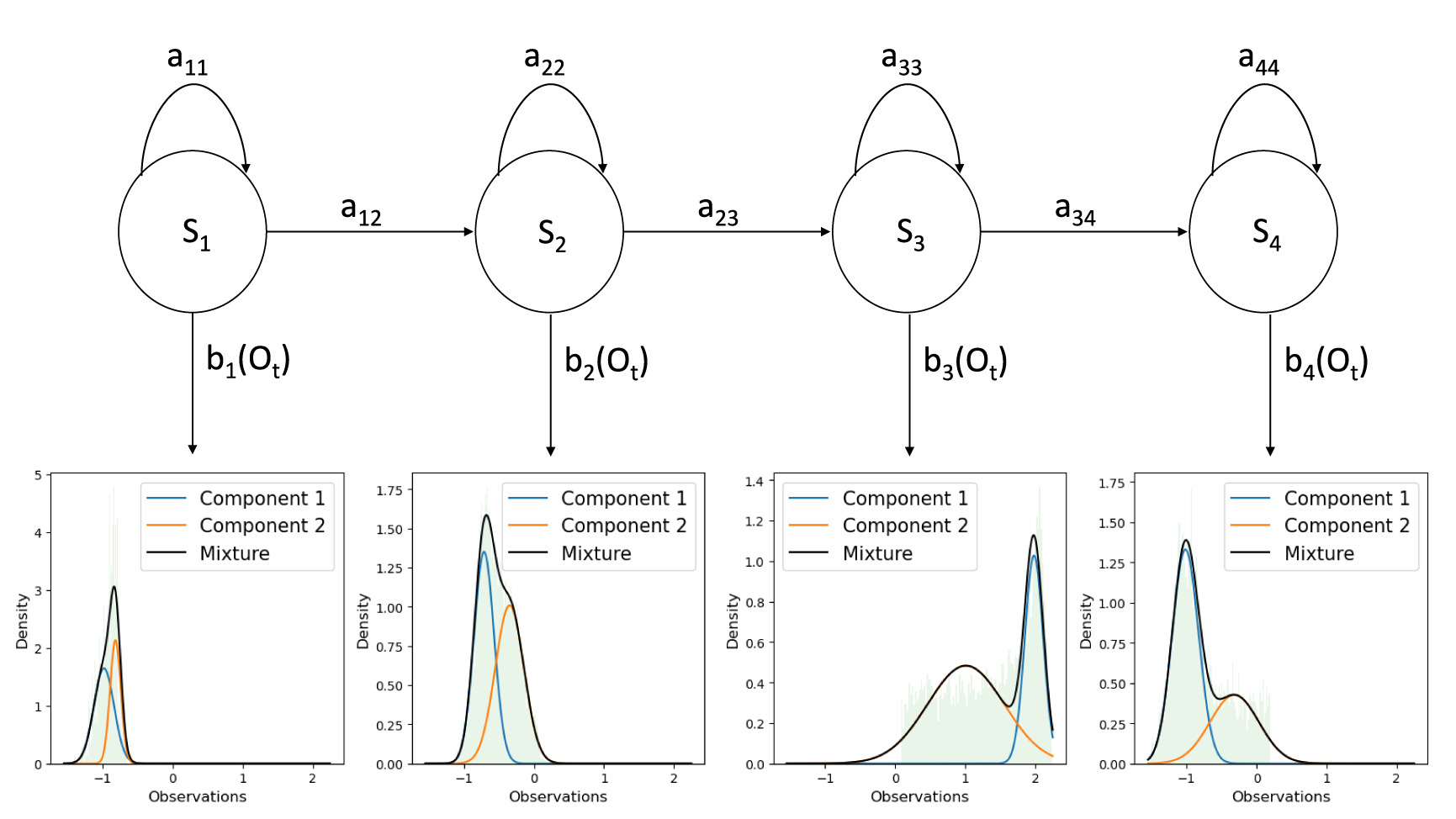
This study addresses the characterization of normal gait and pathological deviations caused by neurological diseases. We focus on the angular knee kinematics in the sagittal plane and we propose to exploit Hidden Markov Models to build a statistical model of normal gait. Such model provides a log-likelihood score that quantifies gait quality. Hence allowing to assess deviations of pathological cycles from normal gait. Our approach allows a refined characterization of motor impairments of three different patients’ groups. In particular, it detects the affected lower limb in Hemiparetic patients. Comparatively to the Gait Variable Score and a Dynamic Time Warping-based metric, our results show that our statistical method is more effective for finely quantifying pathological deviations. Finally, we show the potential use of our methodology to assess therapeutic impacts during gait rehabilitation, which represents a promising avenue for improving patient care.
@article{halimi_novel_2025, title = {A novel gait quality measure for characterizing pathological gait based on {Hidden} {Markov} {Models}}, volume = {184}, hal = {hal-04842998}, doi = {10.1016/j.compbiomed.2024.109368}, urldate = {2025-06-26}, journal = {Computers in Biology and Medicine}, publisher = {Elsevier}, author = {Halimi, Abdelghani and Hermez, Lorenzo and Houmani, Nesma and Garcia-Salicetti, Sonia and Galarraga, Omar}, month = jan, year = {2025}, keywords = {analysis, angle, diseases, Dynamic, gait, Gait, Hidden, joint, Knee, Markov, models, Neurological, Quantified, score, time, variable, warping}, pages = {109368}, } - Quantification des effets thérapeutiques sur la marche chez des patients avec hémiparésie par une mesure de distance élastique multidimensionnelleLorenzo Hermez, Nesma Houmani, Sonia Garcia-Salicetti, Omar Galarraga, and Vincent VigneronIn SOFAMEA 2025 : XXIII congrès de la Société Francophone d’analyse du mouvement chez l’enfant et l’adulte, Jan 2025
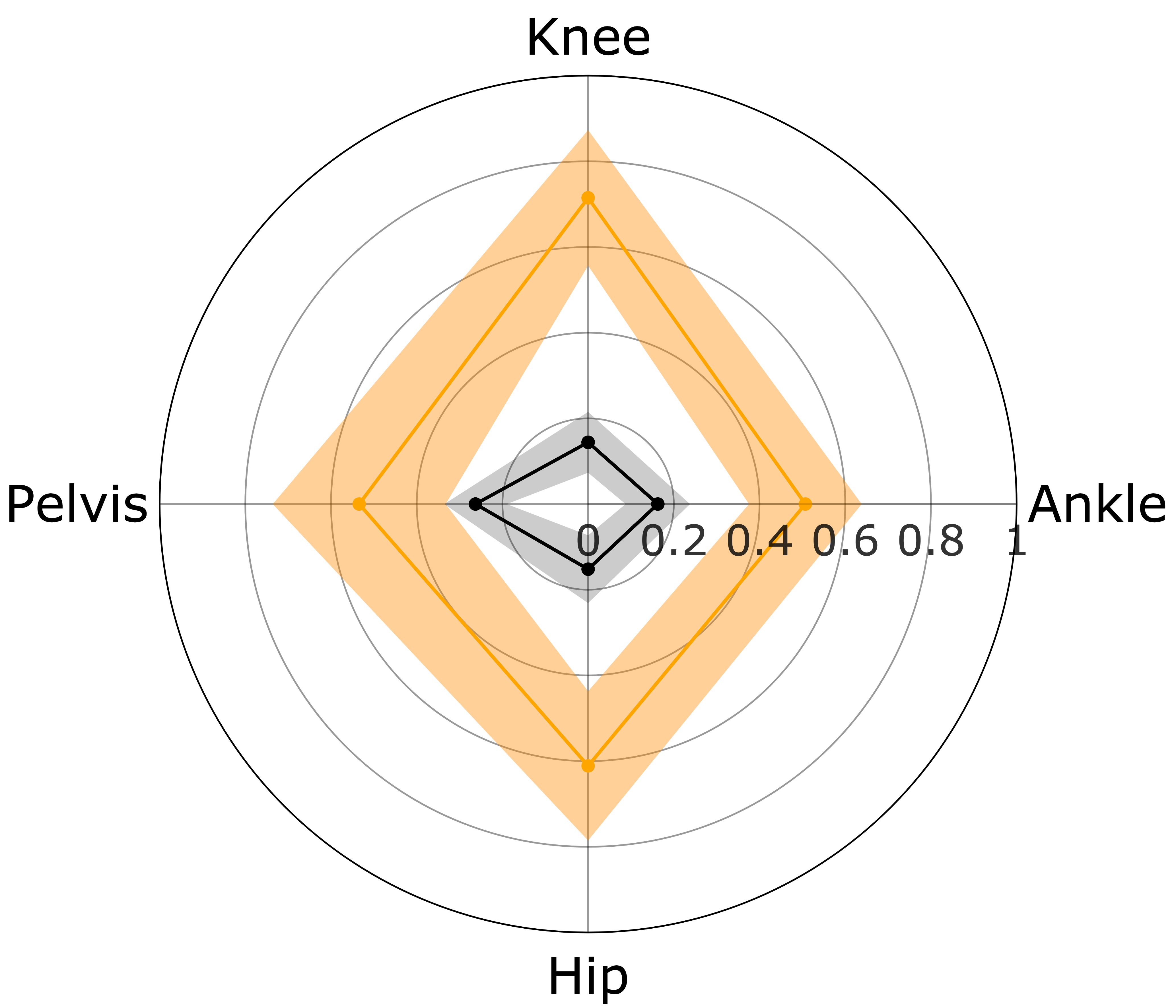
Objectives: The aim of this study is to assess the value of our gait quality measure [1], based on a multidimensional elastic distance, for quantifying the therapeutic effect on gait of botulinum toxin in rehabilitation. Research question: Does the use of several representatives of normal gait, combined with an elastic distance measure to quantify gait deviation, improve the evaluation of the therapeutic protocol? Method: This retrospective study was carried out on 52 control subjects and 21 patients with hemiparesis who received botulinum toxin injections during rehabilitation. We quantified the therapeutic effect by calculating the deviations from an elastic distance of the patients’ cycles at three representatives of normal walking, before and after treatment. We compare this multidimensional measure with the Gait Deviation Index (GDI) [2] and the Global Variable Score (GVS) [3], assessing their respective ability to identify patients’ paretic limb and monitor progress in rehabilitation. Results: Unlike the GDI and GVS, our measure enables us to detect the affected limb in patients before treatment. Significant decreases in deviations from norm representatives were observed after treatment with our measure in patients who had made great progress, while GDI and GPS varied little (Figure 1). Conclusions: The study shows that the use of several normal gait references, combined with an elastic distance measurement, enables accurate spatio-temporal gait analysis. This approach is particularly effective for quantifying pathological gait disorders and assessing the impact of treatments.
@inproceedings{hermez_quantification_2025,
  address = {Paris, France},
  title = {Quantification des effets thérapeutiques sur la marche chez des patients avec hémiparésie par une mesure de distance élastique multidimensionnelle},
  hal = {hal-05120022},
  urldate = {2025-06-26},
  booktitle = {{SOFAMEA} 2025 : {XXIII} congrès de la {Société} {Francophone} d'analyse du mouvement chez l'enfant et l'adulte},
  author = {Hermez, Lorenzo and Houmani, Nesma and Garcia-Salicetti, Sonia and Galarraga, Omar and Vigneron, Vincent},
  month = jan,
  year = {2025},
  keywords = {Gait deviation index, Gait profile score, Dynamic Time Warping, Gait therapy assessment, Normal gait profiles}
}
2024
- Gait Deviation Assessment: From Signal to Image AnalysisLorenzo Hermez, Nesma Houmani, Sonia Garcia-Salicetti, Omar Galarraga, and Vincent VigneronIn 2024 IEEE Thirteenth International Conference on Image Processing Theory, Tools and Applications (IPTA), Oct 2024
In this paper, we propose a novel framework for gait quality assessment based on image analysis, extending the traditional signal-based approach. Specifically, we construct Cycle Dissimilarity Images (CDI) from raw gait signals. Such images summarize all local dissimilarities existing in the dynamics between a gait signal and one normal gait reference. Also, we construct a typical dissimilarity image, by matching each normal gait reference to itself. Then, we propose to quantify gait deviations by computing the distance between the CDIs and the typical dissimilarity images. Our results indicate that, compared to the signal-based approach, this new framework leads to a more precise gait deviation assessment, and a more refined characterization of motor impairments, as hemiparesis, tetraparesis, and paraparesis.
@inproceedings{hermez_gait_2024, title = {Gait {Deviation} {Assessment}: {From} {Signal} to {Image} {Analysis}}, issn = {2154-512X}, shorttitle = {Gait {Deviation} {Assessment}}, url = {https://ieeexplore.ieee.org/document/10755780}, hal = {hal-04843058v1}, doi = {10.1109/IPTA62886.2024.10755780}, urldate = {2025-06-26}, booktitle = {2024 {IEEE} {Thirteenth} {International} {Conference} on {Image} {Processing} {Theory}, {Tools} and {Applications} ({IPTA})}, author = {Hermez, Lorenzo and Houmani, Nesma and Garcia-Salicetti, Sonia and Galarraga, Omar and Vigneron, Vincent}, month = oct, year = {2024}, keywords = {clinical gait analysis, cycle dissimilarity image, deviation score, dynamic time warping, Image analysis, motor impairments, Motors, normal gait reference image, Quality assessment}, pages = {01--06} } - An enhanced characterization of gait deviations in Hemiparesis by combining knee and ankle kinematicsLorenzo Hermez, Nesma Houmani, Sonia Garcia-SalicettiSonia, Galarraga Omar, and Vigneron VincentGait & Posture, Sep 2024
@article{hermez_enhanced_2024, title = {An enhanced characterization of gait deviations in {Hemiparesis} by combining knee and ankle kinematics}, volume = {113}, issn = {0966-6362}, url = {https://www.sciencedirect.com/science/article/pii/S0966636224003187}, doi = {https://doi.org/10.1016/j.gaitpost.2024.07.106}, hal = {hal-04663986v1}, journal = {Gait \& Posture}, author = {Hermez, Lorenzo and Houmani, Nesma and Garcia-SalicettiSonia, Sonia and Omar, Galarraga and Vincent, Vigneron}, month = sep, year = {2024}, pages = {91--92} } - Caractérisation de la marche normale et des déviations pathologiques dues aux maladies neurologiques : étude comparative des mesures de déviations de la marcheLorenzo Hermez, Nesma Houmani, Sonia Garcia-Salicetti, Omar Galarraga, and Vincent VigneronIn SOFAMEA 2024 : XXII congrès de la Société Francophone d’analyse du mouvement chez l’enfant et l’adulte, Jan 2024
@inproceedings{hermez_caracterisation_2024,
  address = {Nantes (France), France},
  title = {Caractérisation de la marche normale et des déviations pathologiques dues aux maladies neurologiques : étude comparative des mesures de déviations de la marche},
  shorttitle = {Caractérisation de la marche normale et des déviations pathologiques dues aux maladies neurologiques},
  hal = {hal-04685982},
  urldate = {2025-06-26},
  booktitle = {{SOFAMEA} 2024 : {XXII} congrès de la {Société} {Francophone} d'analyse du mouvement chez l'enfant et l'adulte},
  author = {Hermez, Lorenzo and Houmani, Nesma and Garcia-Salicetti, Sonia and Galarraga, Omar and Vigneron, Vincent},
  month = jan,
  year = {2024},
  file = {HAL PDF Full Text:/Users/lorenzohermez/Zotero/storage/QDV6FP6Q/Hermez et al. - 2024 - Caractérisation de la marche normale et des déviations pathologiques dues aux maladies neurologiques.pdf:application/pdf}
}
2023
- Gait deviation and neurological diseases: a comparative study of quantitative measuresLorenzo Hermez, Nesma Houmani, Sonia Garcia-Salicetti, Omar Galarraga, and Vincent VigneronIn EHB 2023 : 11th IEEE International Conference on E-Health and Bioengineering, Nov 2023
This comparative study addresses the quantification of gait deviations from normal gait, and across different motor impairments induced by neurological diseases. We compared Gait Deviation Index and Gait Profile Score, well-known in the literature, to a novel 3D-metric based on Dynamic Time Warping (DTW). These deviation measures are analyzed following the same methodology, based on unsupervised learning, on the same database. Results show that our 3D-metric outperforms the other. This confirms that for finely quantifying deviations, it is crucial to consider different references to represent normal gait variability, as well as using an elastic distance (DTW) for matching two gait cycles.
@inproceedings{hermez_gait_2023, address = {Bucharest, Romania}, title = {Gait deviation and neurological diseases: a comparative study of quantitative measures}, volume = {111}, shorttitle = {Gait deviation and neurological diseases}, hal = {hal-04305550}, doi = {10.1007/978-3-031-62523-7_55}, urldate = {2025-06-19}, booktitle = {{EHB} 2023 : 11th {IEEE} {International} {Conference} on {E}-{Health} and {Bioengineering}}, publisher = {Springer Cham}, author = {Hermez, Lorenzo and Houmani, Nesma and Garcia-Salicetti, Sonia and Galarraga, Omar and Vigneron, Vincent}, month = nov, year = {2023}, keywords = {dynamic time warping, gait deviation index, gait profile score, knee angular kinematics., normal gait profiles} } - Clinical Gait Analysis: Characterizing Normal Gait and Pathological Deviations Due to Neurological DiseasesLorenzo Hermez, Abdelghani Halimi, Nesma Houmani, Sonia Garcia-Salicetti, Omar Galarraga, and Vincent VigneronSensors (Basel), Jul 2023
This study addresses the characterization of normal gait and pathological deviations induced by neurological diseases, considering knee angular kinematics in the sagittal plane. We propose an unsupervised approach based on Dynamic Time Warping (DTW) to identify different normal gait profiles (NGPs) corresponding to real cycles representing the overall behavior of healthy subjects, instead of considering an average reference, as done in the literature. The obtained NGPs are then used to measure the deviations of pathological gait cycles from normal gait with DTW. Hierarchical Clustering is applied to stratify deviations into clusters. Results show that three NGPs are necessary to finely characterize the heterogeneity of normal gait and accurately quantify pathological deviations. In particular, we automatically identify which lower limb is affected for Hemiplegic patients and characterize the severity of motor impairment for Paraplegic patients. Concerning Tetraplegic patients, different profiles appear in terms of impairment severity. These promising results are obtained by considering the raw description of gait signals. Indeed, we have shown that normalizing signals removes the temporal properties of signals, inducing a loss of dynamic information that is crucial for accurately measuring pathological deviations. Our methodology could be exploited to quantify the impact of therapies on gait rehabilitation.
@article{hermez_clinical_2023,
  title = {Clinical {Gait} {Analysis}: {Characterizing} {Normal} {Gait} and {Pathological} {Deviations} {Due} to {Neurological} {Diseases}},
  volume = {23},
  issn = {1424-8220},
  shorttitle = {Clinical {Gait} {Analysis}},
  doi = {10.3390/s23146566},
  hal = {hal-04172052v1},
  language = {eng},
  number = {14},
  journal = {Sensors (Basel)},
  author = {Hermez, Lorenzo and Halimi, Abdelghani and Houmani, Nesma and Garcia-Salicetti, Sonia and Galarraga, Omar and Vigneron, Vincent},
  month = jul,
  year = {2023},
  keywords = {3D gait deviation, Biomechanical Phenomena, clinical gait analysis, Dynamic Time Warping, Gait, Humans, Knee Joint, Lower Extremity, Nervous System Diseases, neurological diseases, normal gait characterization, unsupervised machine learning},
  pages = {6566}
}